Use Cases · Incident Response

The search that matters happens at two in the morning.

Incident response is bought under pressure, and increasingly the first question goes to an assistant. GrackerAI shows you whether the engines name you when someone asks who to call, and what would have to exist on your site for them to.

7-day free trial. Cancel anytime before it ends.
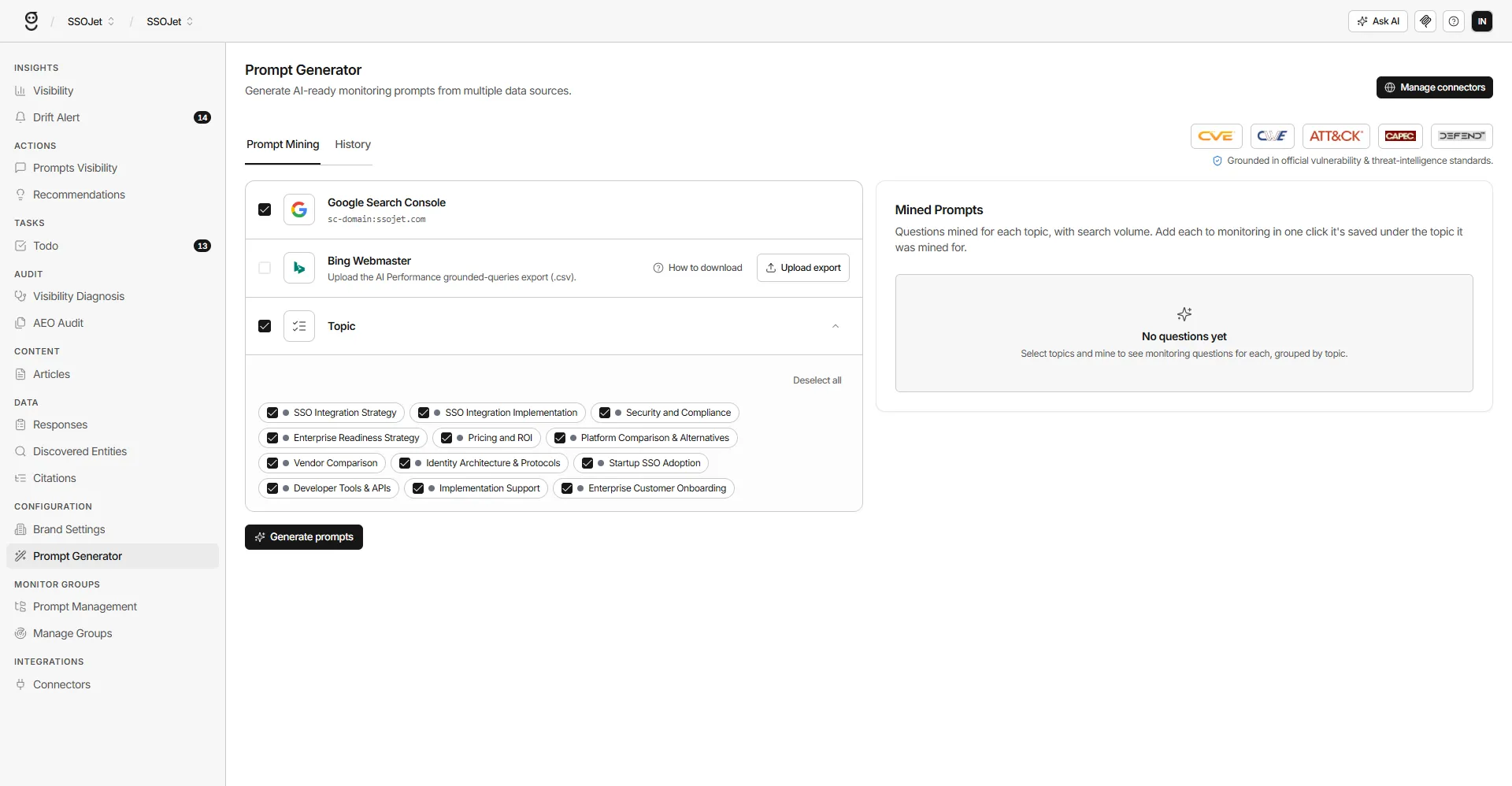
GrackerAI tracking how AI engines answer incident response and DFIR vendor questions
The incident response AEO reality

Under pressure, the first answer is usually the only one considered.

An organisation mid-incident does not run an evaluation. It asks a direct question and acts on the answer. That makes presence in a handful of urgent prompts worth more than broad category visibility ever will be.

Why IR buyers research differently
The urgent search converts immediately There is no evaluation cycle, only a decision made in the next hour
Retainers are bought calmly, in advance Two completely different prompt sets lead to the same service
Legal and insurance shape the choice Cyber insurers and counsel often constrain who can be engaged
Credentials are checked immediately Certifications and published casework are verified before a call is made
What you get

What the platform does when the buyer is mid-incident

Monitoring

Urgent and planned prompts apart

Prompt Topics separates the two-in-the-morning questions from the retainer-planning ones, because they need different pages and convert on completely different timelines.

See Prompt Topics
Intelligence

Who the engines currently recommend

LLM Citations shows which sources the models read when answering an urgent question, which is often an insurer panel list or a directory rather than a vendor site.

See LLM Citations
Verification

Every identifier checked at the authority

CVE, CWE, ATT&CK, CAPEC and NIST references on your pages are resolved against the body that issued them, and an active-exploit claim is checked against CISA's Known Exploited Vulnerabilities catalog.

See Security Verification
Content

Fabricated identifiers never ship

Identifiers are resolved before a draft is written, and anything the model produced that is not in that resolved set is stripped out before the page publishes.

See Content Engine
Monitoring

CVE and news sweeps that become prompts

New vulnerabilities and security news are swept on a schedule, scored for exploitability and for how closely they touch your products, and the survivors become monitored prompts automatically.

See AI Visibility Monitoring
Prompt coverage

The prompts that decide an IR engagement

Urgent prompts skew to ChatGPT for speed; planning and credential questions pull cited sources on Perplexity.

Prompt categoryExample queryWhere it lands most
UrgentWho do we call after a ransomware detonationChatGPTPerplexity
ContainmentFirst steps after confirming a business email compromiseClaudeChatGPT
RetainerDo we need an IR retainer at our sizeChatGPTPerplexity
InsuranceIR firms accepted by cyber insurance panelsPerplexityChatGPT
ForensicsPreserving evidence for a legal case after a breachClaudePerplexity
Plays

Four plays that move IR pipelines

01

Own the emergency question

A handful of urgent prompts convert immediately and nothing else in this category does. Find out whether the engines name you on them, because there is no second chance during an incident.

Explore AI Visibility Monitoring →
02

Capture the calm search too

Retainers are bought in advance by people asking whether they need one. That is a separate prompt set, a separate page and a far longer conversation.

Explore Prompt Topics →
03

Appear where insurers and counsel look

Panel membership and legal acceptability constrain who gets engaged. Citations shows which of those sources the engines actually read when answering.

Explore LLM Citations →
04

Publish casework that checks out

Published incident analysis is the strongest credential in this category, and it is dense with identifiers. Verification resolves each one so the work stands up to the audience that reads it.

Explore Security Verification →
The stack

The right product for every stage of the work

StageWhat you use
Diagnose Find where you are missing todayPrompt Research AI Visibility Monitoring AI Visibility Score
Explain Understand why a prompt goes to someone elseVisibility Diagnosis LLM Citations Competitor Monitoring
Fix Turn findings into published pagesTechnical AEO Audit Recommendation Engine Content Engine
Ship Get it live and keep it movingTasks WordPress Publishing AI Search Analytics

Frequently Asked Questions

Questions B2B SaaS teams ask before getting started

The same all 10 AI engines it tracks for every vertical: ChatGPT, Perplexity, Google AI Mode, Google AI Overviews, Gemini, Microsoft Copilot, DeepSeek, Brave Leo, Grok and Claude. Coverage is by plan — 3 engines on Starter, 4 on Scale and all 10 on Enterprise.

Urgent and planning prompts are tracked as separate topics because they convert on completely different timelines, and identifiers in published casework are resolved against the issuing authorities.

Monitoring starts returning answers on the first run, so you can see where you stand immediately. Movement in citations follows publishing, which depends on how fast you ship the fixes the audit and diagnosis hand you.

No. Classic SEO governs ranking; AEO and GEO govern whether a model quotes you. The technical audit overlaps with an SEO audit in places, but the citation work sits alongside what you already do rather than replacing it.

Ready to see your AI visibility score?

60 seconds. 7-day free trial, cancel anytime.

Do not let AI keep
recommending someone else

Start your 7-day free trial and get your AI Visibility Score in about a minute. See exactly where you stand, where competitors are beating you, and the ranked fixes to get into the answer. Cancel anytime before the trial ends.

7-day free trial. Cancel anytime before it ends. Trusted by 500+ B2B SaaS teams.

Partnered with
  • Microsoft
  • Google
  • Amazon AWS
  • Cloudflare
  • Nvidia
Powered by
  • Google Gemini
  • Open AI
  • Claude