Use Cases · Endpoint Security

Every endpoint evaluation starts as "EDR, XDR, or just let someone run it for us?"

That question is now asked of an assistant before it is asked of a vendor, and the answer decides whether you are in a product conversation or a managed-service one. GrackerAI shows you which of those framings currently name you.

7-day free trial. Cancel anytime before it ends.
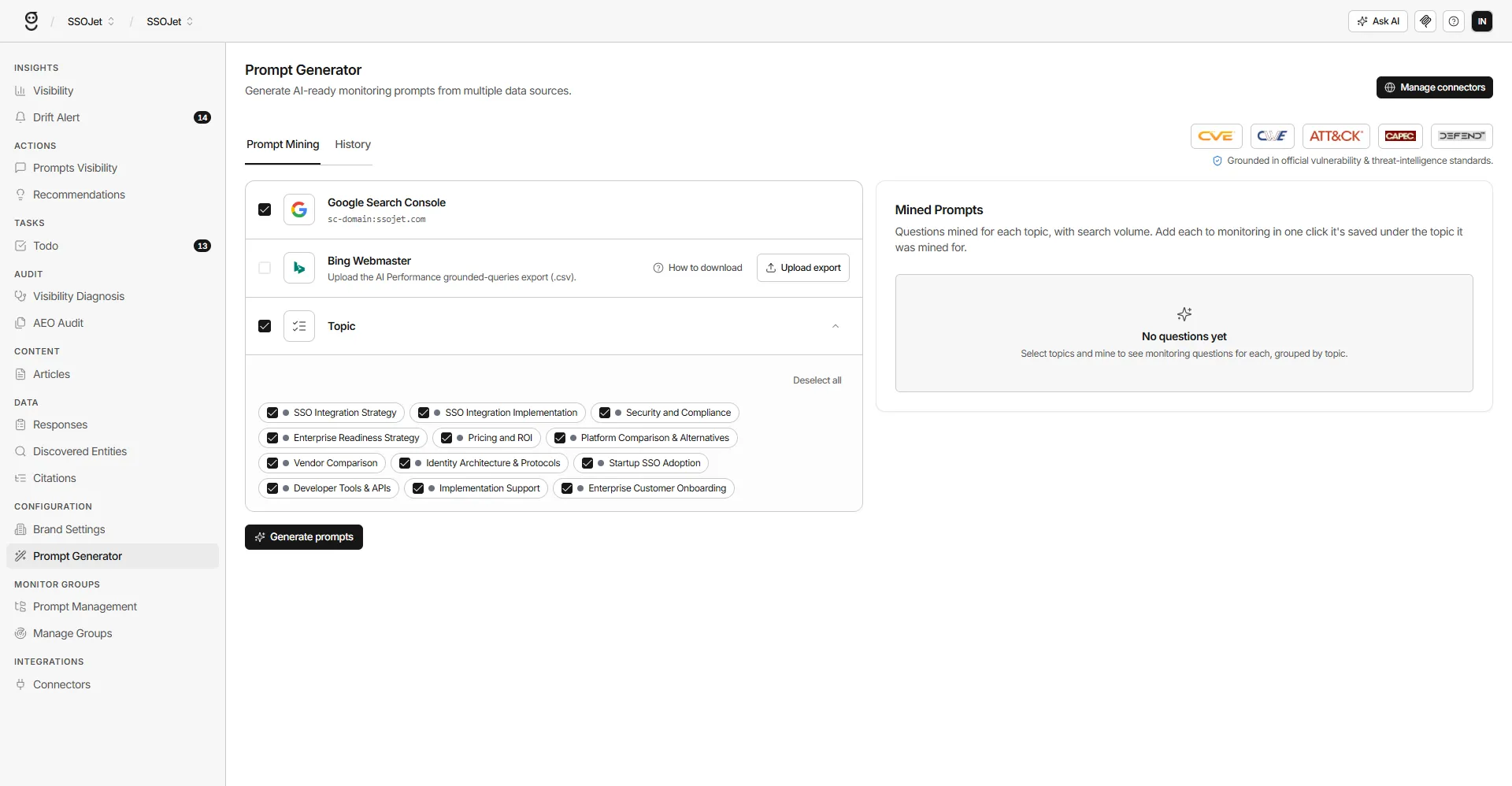
GrackerAI tracking how AI engines recommend endpoint platforms across EDR, XDR and MDR
The endpoint security AEO reality

The model decides the framing, and the framing decides the deal.

EDR, XDR and MDR are three answers to one problem with very different commercial shapes. When an assistant picks a framing for a buyer, it has already narrowed the field — often before anyone has evaluated a detection claim.

Why endpoint buyers research differently
Build-or-outsource comes first Whether to run it in-house reshapes the shortlist before products are compared
SOC headcount decides feasibility A tool that assumes a staffed 24/7 SOC is wrong for most buyers asking
Independent test results get quoted Models repeat published evaluation outcomes, whoever published them
Coverage gaps are checked early macOS, Linux and mobile support is verified before anything else is discussed
What you get

What the platform does when the framing decides the deal

Monitoring

EDR, XDR and MDR tracked apart

Prompt Topics keeps the three framings separate, so you can see whether the engines put you in the product conversation, the managed one, or neither.

See Prompt Topics
Intelligence

How the answer characterises you

Brand Sentiment tracks the qualifiers attached to your name, which in this category usually means claims about noise, agent weight or operational burden.

See Brand Sentiment
Verification

Every identifier checked at the authority

CVE, CWE, ATT&CK, CAPEC and NIST references on your pages are resolved against the body that issued them, and an active-exploit claim is checked against CISA's Known Exploited Vulnerabilities catalog.

See Security Verification
Content

Fabricated identifiers never ship

Identifiers are resolved before a draft is written, and anything the model produced that is not in that resolved set is stripped out before the page publishes.

See Content Engine
Monitoring

CVE and news sweeps that become prompts

New vulnerabilities and security news are swept on a schedule, scored for exploitability and for how closely they touch your products, and the survivors become monitored prompts automatically.

See AI Visibility Monitoring
Prompt coverage

The prompts that decide an endpoint shortlist

These prompts pull cited sources often, especially where independent test results exist, so weight Perplexity and Claude.

Prompt categoryExample queryWhere it lands most
FramingDo we need EDR or a managed MDR serviceChatGPTPerplexity
CapacityBest endpoint platform for a team without a 24/7 SOCChatGPTClaude
CoverageEndpoint tools with real Linux and macOS parityClaudePerplexity
EvidenceWhich EDR performed best in independent testingPerplexityChatGPT
ReplacementMigrating off a legacy antivirus estateChatGPTPerplexity
Plays

Four plays that move endpoint pipelines

01

Appear in both framings

If the engines only ever name you as a product, you never reach buyers who asked whether to outsource. Track the framings separately and publish for the one you are missing.

Explore Prompt Topics →
02

Own how test results are summarised

Independent evaluations get quoted heavily and rarely in full. Citations shows which summaries the engines actually read, so you can see what shaped the sentence about you.

Explore LLM Citations →
03

Answer the coverage question explicitly

Platform parity is checked early and models fill gaps with assumptions. An explicit, current coverage page removes an objection you are otherwise losing silently.

Explore Content Engine →
04

Catch a qualifier before it sets

Sentiment moves before share of voice. A model that begins hedging about agent overhead is repeating something it read, and that source is findable.

Explore Brand Sentiment →
The stack

The right product for every stage of the work

StageWhat you use
Diagnose Find where you are missing todayPrompt Research AI Visibility Monitoring AI Visibility Score
Explain Understand why a prompt goes to someone elseVisibility Diagnosis LLM Citations Competitor Monitoring
Fix Turn findings into published pagesTechnical AEO Audit Recommendation Engine Content Engine
Ship Get it live and keep it movingTasks WordPress Publishing AI Search Analytics

Frequently Asked Questions

Questions B2B SaaS teams ask before getting started

The same all 10 AI engines it tracks for every vertical: ChatGPT, Perplexity, Google AI Mode, Google AI Overviews, Gemini, Microsoft Copilot, DeepSeek, Brave Leo, Grok and Claude. Coverage is by plan — 3 engines on Starter, 4 on Scale and all 10 on Enterprise.

The EDR, XDR and MDR framings are tracked as separate topics because they lead to different commercial conversations, and sentiment is watched alongside share of voice since operational objections decide this category.

Monitoring starts returning answers on the first run, so you can see where you stand immediately. Movement in citations follows publishing, which depends on how fast you ship the fixes the audit and diagnosis hand you.

No. Classic SEO governs ranking; AEO and GEO govern whether a model quotes you. The technical audit overlaps with an SEO audit in places, but the citation work sits alongside what you already do rather than replacing it.

Ready to see your AI visibility score?

60 seconds. 7-day free trial, cancel anytime.

Do not let AI keep
recommending someone else

Start your 7-day free trial and get your AI Visibility Score in about a minute. See exactly where you stand, where competitors are beating you, and the ranked fixes to get into the answer. Cancel anytime before the trial ends.

7-day free trial. Cancel anytime before it ends. Trusted by 500+ B2B SaaS teams.

Partnered with
  • Microsoft
  • Google
  • Amazon AWS
  • Cloudflare
  • Nvidia
Powered by
  • Google Gemini
  • Open AI
  • Claude