Use Cases · Compliance & Risk

Every buyer arrives with a framework name and a deadline.

Compliance software is searched for by framework and by audit date, not by category. GrackerAI shows you which framework answers name you, which name a competitor, and what to publish before the next audit season starts.

7-day free trial. Cancel anytime before it ends.
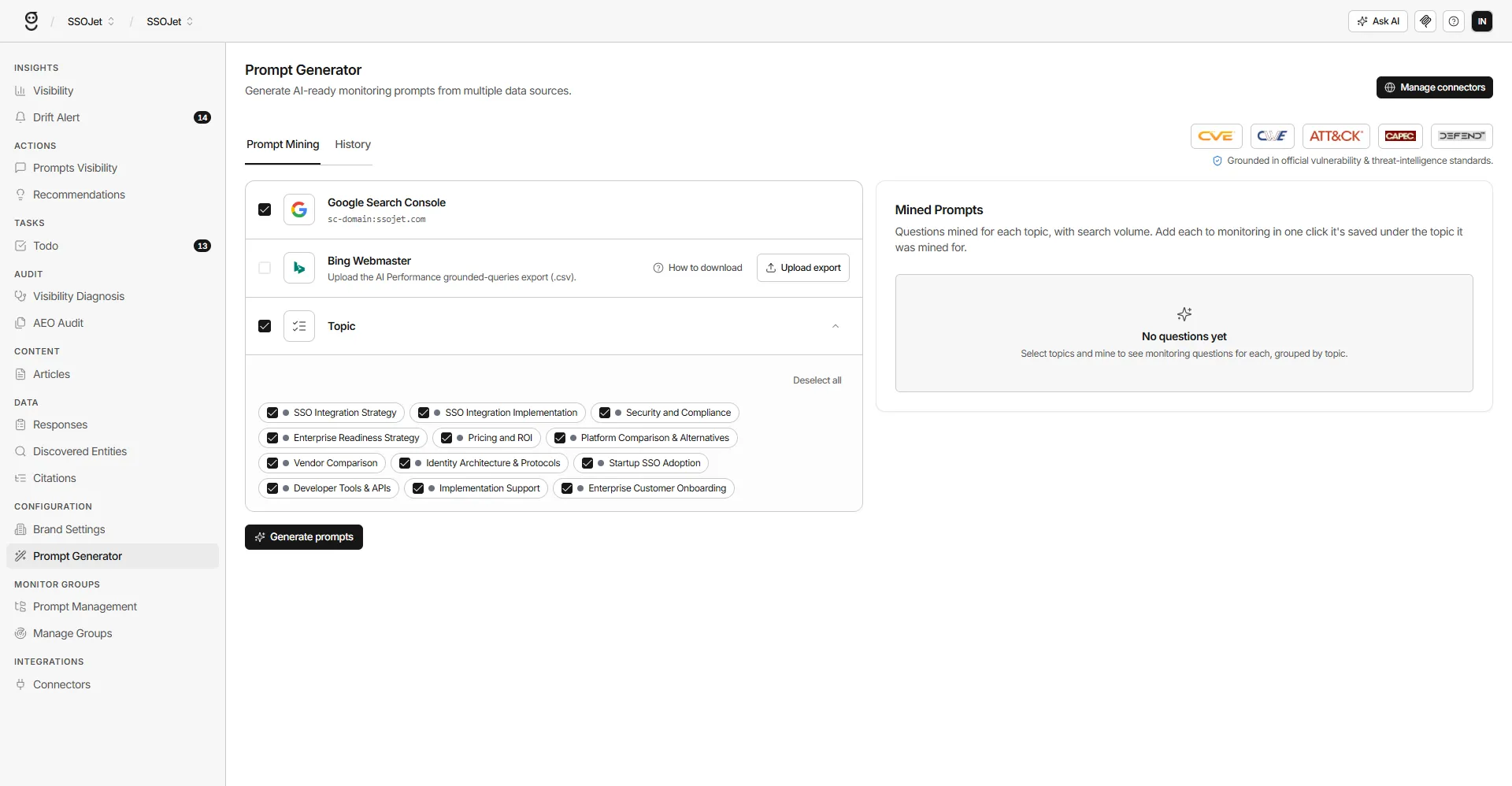
GrackerAI tracking how AI engines recommend GRC platforms across SOC 2, ISO 27001 and HIPAA
The GRC AEO reality

The query is the framework, and the deadline is the urgency.

Nobody searches for a GRC platform in the abstract. They search because an audit is scheduled, and they name the framework. That makes per-framework presence worth far more than general category visibility.

Why compliance buyers research differently
They search by framework, never by category SOC 2, ISO 27001, HIPAA and PCI DSS are the actual queries
A deadline is driving the search Urgency compresses evaluation and rewards whoever is already in the answer
Auditor acceptance is the real question Buyers ask what auditors will accept, not what the tool can produce
Overlapping frameworks are the pain Mapping one control set across several frameworks is the job to be done
What you get

What the platform does when the query is a framework name

Monitoring

One topic per framework

Prompt Topics tracks SOC 2, ISO 27001, HIPAA and the rest separately, so you can see which framework you own and which one belongs to a competitor.

See Prompt Topics
Audit

Standards references that resolve

The audit checks that a named publication such as NIST SP 800-53 is linked, live, real at the issuing body and relevant to the claim beside it, rather than merely mentioned.

See Security Verification
Verification

Every identifier checked at the authority

CVE, CWE, ATT&CK, CAPEC and NIST references on your pages are resolved against the body that issued them, and an active-exploit claim is checked against CISA's Known Exploited Vulnerabilities catalog.

See Security Verification
Content

Fabricated identifiers never ship

Identifiers are resolved before a draft is written, and anything the model produced that is not in that resolved set is stripped out before the page publishes.

See Content Engine
Monitoring

CVE and news sweeps that become prompts

New vulnerabilities and security news are swept on a schedule, scored for exploitability and for how closely they touch your products, and the survivors become monitored prompts automatically.

See AI Visibility Monitoring
Prompt coverage

The prompts that decide a GRC shortlist

Framework prompts pull cited sources heavily, which makes Perplexity the engine to weight most for this vertical.

Prompt categoryExample queryWhere it lands most
FrameworkBest tools for SOC 2 Type II readinessPerplexityChatGPT
OverlapMapping ISO 27001 controls onto SOC 2ClaudePerplexity
Auditor fitWhich evidence formats auditors actually acceptPerplexityClaude
SpeedFastest path to SOC 2 for a 30-person companyChatGPTPerplexity
SectorHIPAA compliance tooling for a health startupPerplexityChatGPT
Plays

Four plays that move GRC pipelines

01

Take one framework at a time

A page per framework beats a page about compliance. Track each framework as its own topic and publish where the engines currently answer without you.

Explore Prompt Topics →
02

Make every control reference real

A page citing NIST SP 800-53 should link to it and it should resolve. Verification checks each named publication against the issuing catalog, which is the whole argument for buying a compliance tool.

Explore Security Verification →
03

Answer the auditor question

Buyers want to know what will be accepted, not what can be exported. That prompt set is where trust is won and is usually answered by a consultancy blog rather than a vendor.

Explore LLM Citations →
04

Be ready before audit season

Search interest in this category is seasonal and deadline-driven. Monitoring shows the shift early enough that publishing lands before the surge rather than during it.

Explore AI Visibility Monitoring →
The stack

The right product for every stage of the work

StageWhat you use
Diagnose Find where you are missing todayPrompt Research AI Visibility Monitoring AI Visibility Score
Explain Understand why a prompt goes to someone elseVisibility Diagnosis LLM Citations Competitor Monitoring
Fix Turn findings into published pagesTechnical AEO Audit Recommendation Engine Content Engine
Ship Get it live and keep it movingTasks WordPress Publishing AI Search Analytics

Frequently Asked Questions

Questions B2B SaaS teams ask before getting started

The same all 10 AI engines it tracks for every vertical: ChatGPT, Perplexity, Google AI Mode, Google AI Overviews, Gemini, Microsoft Copilot, DeepSeek, Brave Leo, Grok and Claude. Coverage is by plan — 3 engines on Starter, 4 on Scale and all 10 on Enterprise.

Each framework is tracked as its own topic rather than as one compliance score, and named publications such as NIST SP 800-53 are verified against the issuing catalog before anything publishes.

Monitoring starts returning answers on the first run, so you can see where you stand immediately. Movement in citations follows publishing, which depends on how fast you ship the fixes the audit and diagnosis hand you.

No. Classic SEO governs ranking; AEO and GEO govern whether a model quotes you. The technical audit overlaps with an SEO audit in places, but the citation work sits alongside what you already do rather than replacing it.

Ready to see your AI visibility score?

60 seconds. 7-day free trial, cancel anytime.

Do not let AI keep
recommending someone else

Start your 7-day free trial and get your AI Visibility Score in about a minute. See exactly where you stand, where competitors are beating you, and the ranked fixes to get into the answer. Cancel anytime before the trial ends.

7-day free trial. Cancel anytime before it ends. Trusted by 500+ B2B SaaS teams.

Partnered with
  • Microsoft
  • Google
  • Amazon AWS
  • Cloudflare
  • Nvidia
Powered by
  • Google Gemini
  • Open AI
  • Claude