Use Cases · Application Security

Your buyer is a developer, and they are asking the assistant inside the workflow.

AppSec tooling is chosen by the people who have to live with it. They ask Claude and ChatGPT which scanner to put in the pipeline, how noisy it is and whether it will block a merge. GrackerAI shows you which of those answers name you.

7-day free trial. Cancel anytime before it ends.
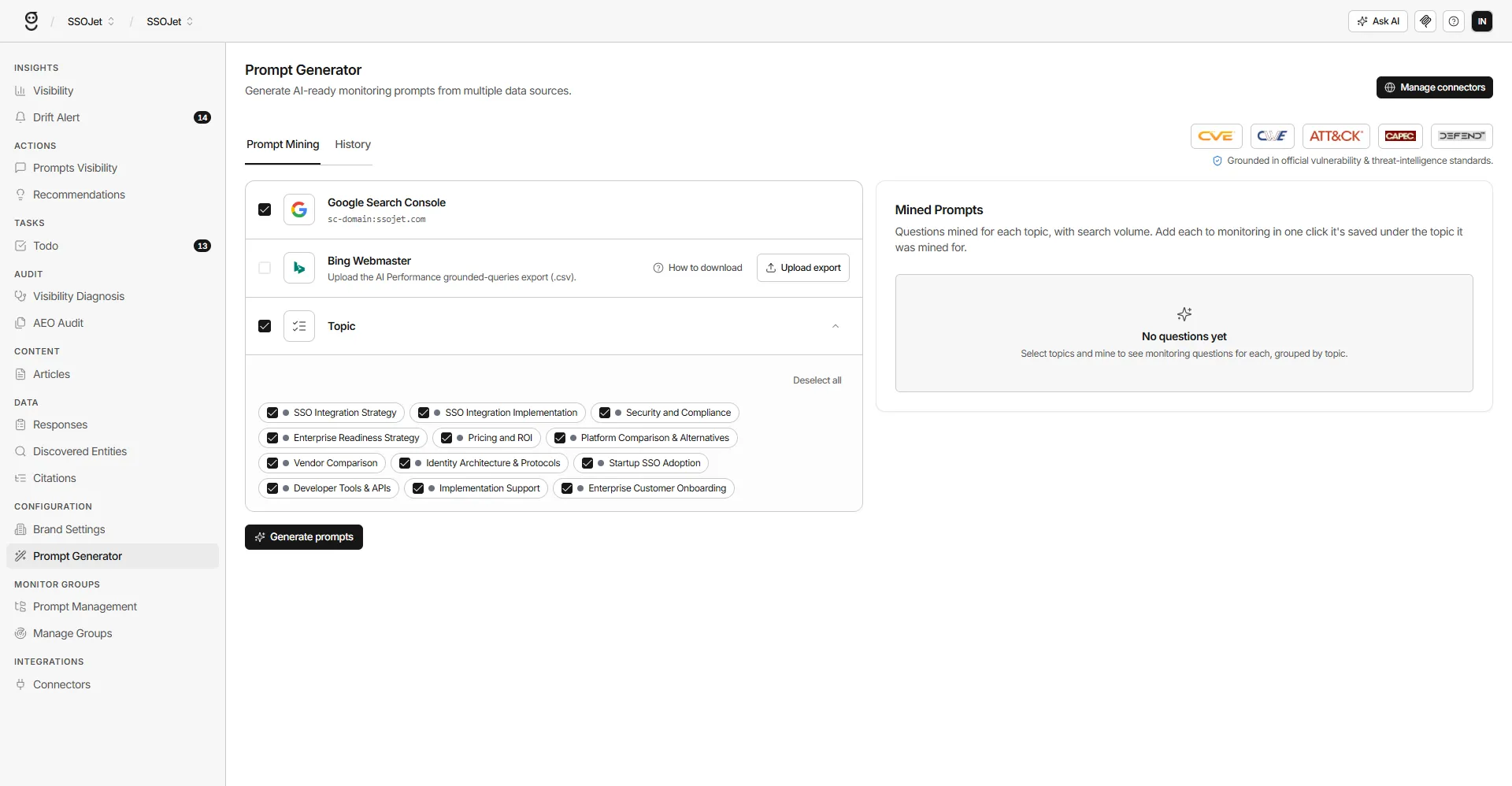
GrackerAI tracking how AI engines recommend application security scanners across SAST, DAST and SCA
The application security AEO reality

The tool that wins is the one developers do not route around.

AppSec adoption is decided by friction, not by detection tables. Assistants answer that way too — with pipeline fit, signal quality and time cost — which makes the prompts that decide your category quite different from the ones a security marketer would expect.

Why AppSec buyers research differently
Pipeline fit is the first question Whether it blocks a merge matters more than what it can detect
False positives are the deciding objection Signal quality is raised earlier and more often than coverage
Open source sets the baseline Every commercial tool is compared against a free one that is already installed
Scan time is a real constraint A scanner that adds ten minutes to CI gets disabled, not evaluated
What you get

What the platform does when the buyer writes the code

Monitoring

Pipeline-shaped prompt coverage

Prompt Mining builds monitors from implementation questions — how a scanner behaves in CI, what it does to build time, how noisy it is — rather than the category headlines that never decide an AppSec purchase.

See Prompt Mining
Audit

Docs read the way an engine reads them

The Technical AEO Audit fetches your documentation before JavaScript runs, so you learn whether the integration guide developers rely on is actually extractable or merely looks complete in a browser.

See AEO Audit
Verification

Every identifier checked at the authority

CVE, CWE, ATT&CK, CAPEC and NIST references on your pages are resolved against the body that issued them, and an active-exploit claim is checked against CISA's Known Exploited Vulnerabilities catalog.

See Security Verification
Content

Fabricated identifiers never ship

Identifiers are resolved before a draft is written, and anything the model produced that is not in that resolved set is stripped out before the page publishes.

See Content Engine
Monitoring

CVE and news sweeps that become prompts

New vulnerabilities and security news are swept on a schedule, scored for exploitability and for how closely they touch your products, and the survivors become monitored prompts automatically.

See AI Visibility Monitoring
Prompt coverage

The prompts that decide an AppSec shortlist

Developer-shaped security prompts land hardest on Claude, with Perplexity close behind on comparison questions.

Prompt categoryExample queryWhere it lands most
PipelineSAST that runs in CI without blocking every mergeClaudeChatGPT
SignalWhich SCA tools have the fewest false positivesPerplexityClaude
Open sourceIs a commercial DAST worth it over ZAPClaudePerplexity
CoverageScanning a monorepo with mixed languagesClaudeChatGPT
RuntimeWAF or RASP for an API-heavy applicationPerplexityClaude
Plays

Four plays that move AppSec pipelines

01

Answer the friction question first

Developers ask what a scanner costs them in time and noise before they ask what it finds. Those prompts decide the category and are almost never the ones on a security content calendar.

Explore Prompt Mining →
02

Make integration docs quotable

Engines quote documentation more readily than product pages, but only when it parses. Run the audit across your docs so the integration guide you already wrote is available to be cited.

Explore AEO Audit →
03

Meet the open-source comparison head on

Every evaluation includes a free alternative that is already installed. If the engines answer that comparison without you, they answer it against you. Find those prompts and publish the honest version.

Explore Diagnosis →
04

Keep every CWE reference real

AppSec content is dense with CWE and CVE identifiers. Verification resolves each one against MITRE so a page about finding vulnerabilities does not itself contain an invented one.

Explore Security Verification →
The stack

The right product for every stage of the work

StageWhat you use
Diagnose Find where you are missing todayPrompt Research AI Visibility Monitoring AI Visibility Score
Explain Understand why a prompt goes to someone elseVisibility Diagnosis LLM Citations Competitor Monitoring
Fix Turn findings into published pagesTechnical AEO Audit Recommendation Engine Content Engine
Ship Get it live and keep it movingTasks WordPress Publishing AI Search Analytics

Frequently Asked Questions

Questions B2B SaaS teams ask before getting started

The same all 10 AI engines it tracks for every vertical: ChatGPT, Perplexity, Google AI Mode, Google AI Overviews, Gemini, Microsoft Copilot, DeepSeek, Brave Leo, Grok and Claude. Coverage is by plan — 3 engines on Starter, 4 on Scale and all 10 on Enterprise.

Monitors are built from pipeline and signal-quality questions rather than detection-coverage headlines, the audit is run against documentation where developers read, and CWE and CVE references are resolved against MITRE before anything publishes.

Monitoring starts returning answers on the first run, so you can see where you stand immediately. Movement in citations follows publishing, which depends on how fast you ship the fixes the audit and diagnosis hand you.

No. Classic SEO governs ranking; AEO and GEO govern whether a model quotes you. The technical audit overlaps with an SEO audit in places, but the citation work sits alongside what you already do rather than replacing it.

Ready to see your AI visibility score?

60 seconds. 7-day free trial, cancel anytime.

Do not let AI keep
recommending someone else

Start your 7-day free trial and get your AI Visibility Score in about a minute. See exactly where you stand, where competitors are beating you, and the ranked fixes to get into the answer. Cancel anytime before the trial ends.

7-day free trial. Cancel anytime before it ends. Trusted by 500+ B2B SaaS teams.

Partnered with
  • Microsoft
  • Google
  • Amazon AWS
  • Cloudflare
  • Nvidia
Powered by
  • Google Gemini
  • Open AI
  • Claude