AI Visibility Intelligence · AI Visibility Score

All of AI search, in one honest number.

Across eight engines, dozens of buyer questions, and answers that change every time you ask, the real question is simple: are you winning or losing? The AI Visibility Score answers it with a single figure from 0 to 100, then shows you where that figure sits against the competitors you actually face.

No credit card required. Your score in about a minute.

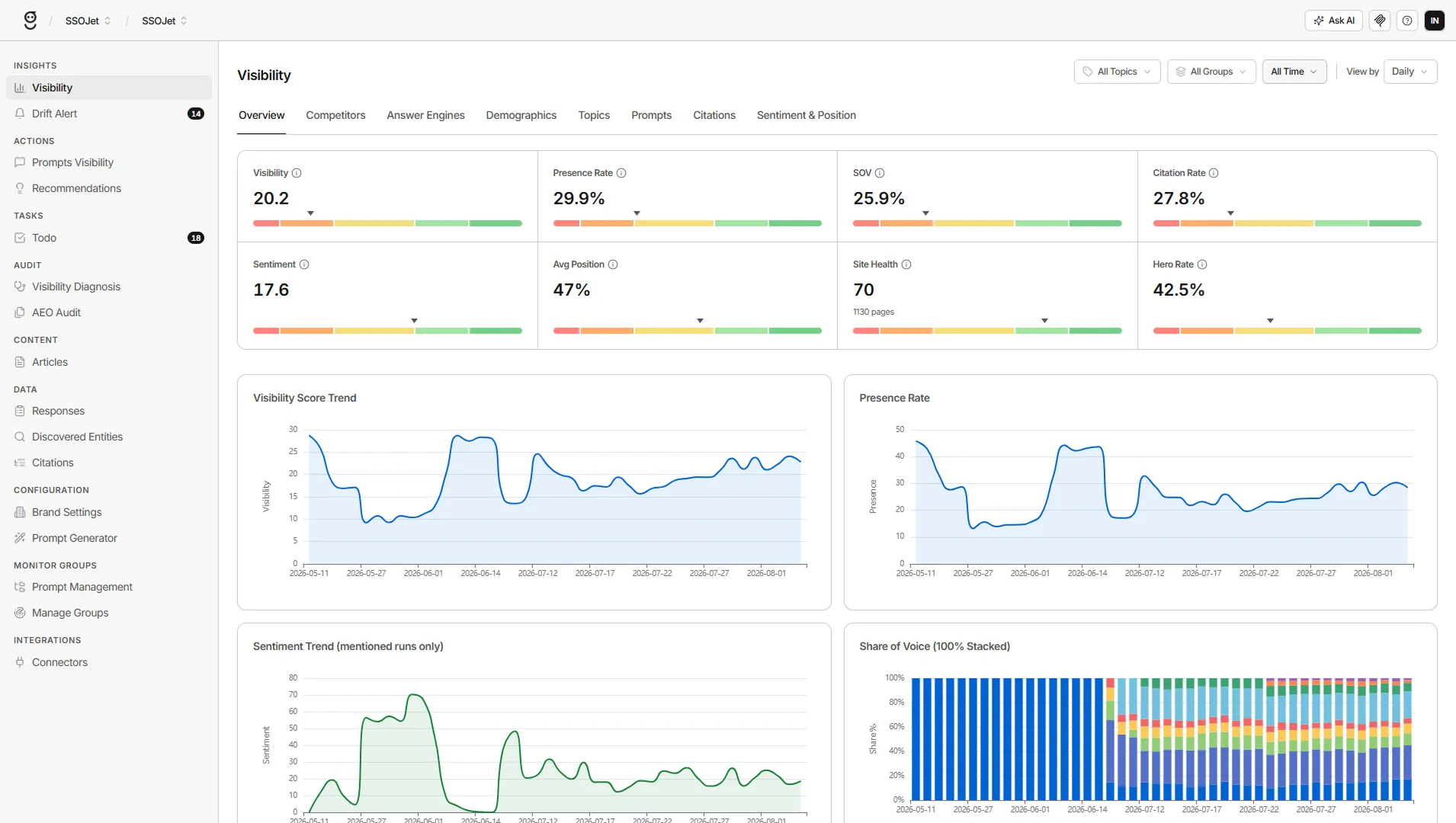
GrackerAI dashboard showing AEO and GEO citation tracking across ChatGPT, Perplexity, Claude, and Gemini
The problem with AI dashboards

A wall of dashboards is not an answer. Your CEO asks how you are doing in AI search. You have ten charts and no number.

Mentions here, sentiment there, citations on a third tab — all of it spread across eight engines. Every chart is true and none of them answers the only question leadership actually asks.

The overload

Too much data, no verdict

You can see everything and still not know if you are ahead. The signals that matter get lost next to the ones that do not, and nobody agrees on which is which.

The missing context

A number with nothing beside it

Say your score is 60. Good or bad depends entirely on your category. Without knowing where the leaders sit, the figure tells you nothing you can act on.

The standstill

Nothing to aim at

You cannot set a goal, judge a campaign, or show the board progress without one stable measure that means the same thing month after month.

One figure, measured the same way every time and placed next to your real competitors, so "how are we doing in AI search" finally has an answer.

How the score is built

From thousands of messy answers to one number you can trust

The score is not a tab you read off a report. It is the end of a pipeline that takes every answer we capture, judges each one, weighs the parts that matter, and lands on a single figure.

Collect

Pull every captured answer across engines, personas and regions.

Score signals

Rate presence, prominence, sentiment, citations and reach.

Weight

Count the moments that matter most, tuned to your category.

Normalize

Map to a 0–100 scale so any company is comparable.

72 Your score

Stable, repeatable, ready to track.

Many noisy inputs go in. One steady, comparable number comes out.

The hard part we solved

Turning all of that into a single figure is the real work, and it is not an average of a column of numbers. Each answer carries six separate signals, each engine reaches a different size of audience, and the same prompt returns slightly different replies every time you ask. A plain average would either drown the signals that count or swing from one day to the next for no real reason.

So every part is weighted. Being named first in a ChatGPT answer that millions of buyers see counts for far more than a passing mention buried in a quiet reply. The weights themselves are tuned per category, because what makes a cybersecurity vendor look authoritative is not what makes a project tool look authoritative. Then the result is normalized to 0 to 100, so a five-person startup and a public company can sit on the same axis and the comparison still holds.

What goes into the number

Five things decide whether AI treats you as the answer

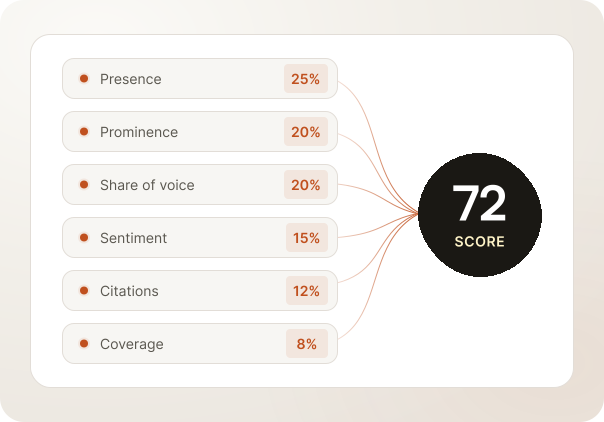
The score is a blend, not a single measurement. It asks how often you show up, how high in the answer, how warmly you are described, whether trusted sources back you, and how much of the conversation you own versus your rivals.

Those weights are not fixed. They shift by category, because authority looks different in security than it does in HR software, and the score reflects that.

  • Presence: how often you are mentioned at all
  • Prominence: first line of the answer or buried at the bottom
  • Sentiment: recommended warmly or mentioned with caution
  • Citations: whether credible sources back the mention
  • Share of voice: your slice of the answer next to competitors
Diagram showing the five components — presence, prominence, sentiment, citations, and share of voice — that combine into the AI Visibility Score
Why the number holds still

A score that moves only when your standing really moves

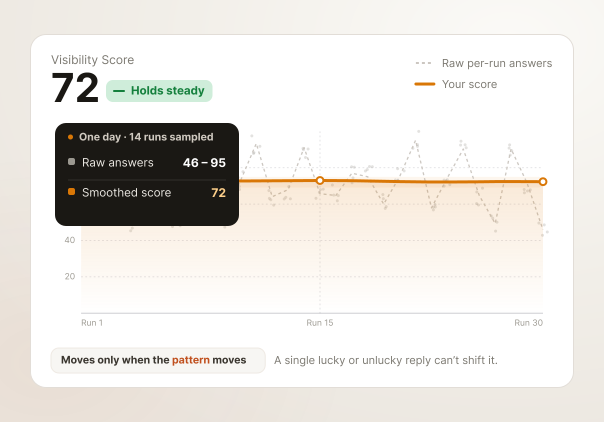
Chart showing a smoothed AI Visibility Score trend line that filters out day-to-day model noise, so only genuine changes move the number

A metric you cannot trust is worse than no metric. If the figure jumped around every day because a model worded things differently, you could never set a goal against it or report it with a straight face.

The hard part we solved

Because the answers underneath shift from one run to the next, we sample each prompt many times and smooth the results before they ever reach your score. A single lucky or unlucky reply cannot move the needle on its own. The score changes when the pattern across many answers changes, which means a rise or a drop is real, and worth acting on, rather than noise dressed up as news.

The Visibility Index

A score means nothing until you see who is around you

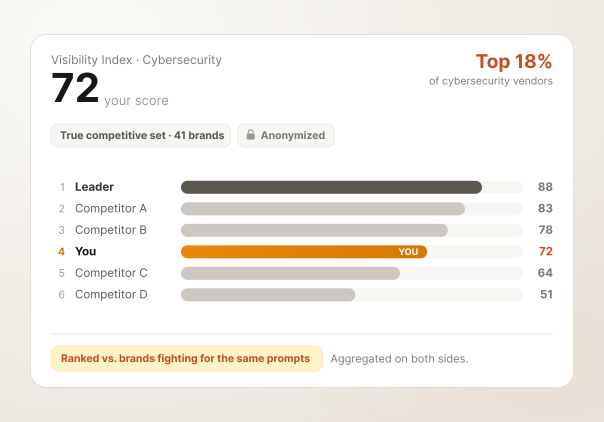
72 sounds healthy until you learn the leaders in your space sit at 88. So the score never travels alone. We place it inside your category and rank it against anonymized data from other brands competing for the same answers, then turn that into a plain statement like 'top 18 percent of cybersecurity vendors.'

  • Ranked against your true competitive set, not a broad label
  • Plain-language percentile, ready to put in front of a board
  • Aggregated and anonymized on both sides
Bell-curve chart showing a brand's score of 72 placed in the top 18 percent of its category on the visibility index
It gets sharper over time

Every brand that joins makes the benchmark better for everyone

Two distribution curves comparing a sparse 12-brand benchmark against a precise 300-brand benchmark, showing how the index tightens as more brands join

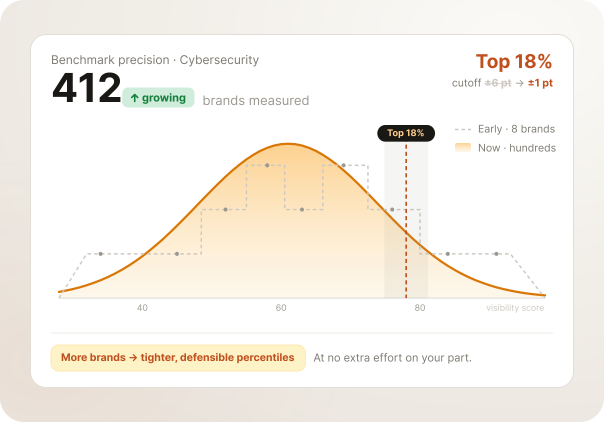
A percentile is only as good as the data behind it. With a handful of companies, 'top 15 percent' is a rough estimate. With hundreds, the distribution fills in, the cutoffs tighten, and the same phrase becomes a precise, defensible line.

That is the quiet advantage of a shared index. It is not static. It compounds. The longer the platform runs and the more brands measure themselves on it, the more accurate your own standing becomes, at no extra effort on your part.

  • More brands means tighter, more reliable percentiles
  • Category definitions get more precise as data grows
  • Your benchmark improves on its own as the network grows
How it compares

A raw dashboard reports activity. A score reports whether you are winning.

A typical visibility dashboardThe AI Visibility Score
Many separate metrics to interpretOne figure your whole team understands
A number with no contextRanked against your real competitive set
Swings with day-to-day model noiseSmoothed, so it moves only on real change
Treats every mention the sameWeights the moments that actually matter
Compares startups and giants unfairlyNormalized so the comparison is fair
Gets no better over timeSharpens as more brands join the index
In action

What one good number lets a team do

The value is not the figure itself. It is everything a clear, trusted figure makes possible.

Report to the board

Leadership does not want ten charts. They want to know if the investment is working. The score gives you one line they instantly understand.

  1. Open the review with a single figure and its trend: 72, up 8 this quarter.
  2. Put it in context with the percentile: now in the top 18 percent of the category.
  3. Tie the rise to the work that caused it, so the program proves its own value.
  4. Set next quarter's target in the same language everyone already gets.

Set a target and track it

A stable number turns a vague ambition into a measurable goal you can run campaigns against.

  1. Pick a target, for example reaching the top 10 percent of your category.
  2. See which components are holding you back, like weak prominence or thin citations.
  3. Ship content and fixes aimed squarely at those components.
  4. Watch the score climb and confirm the work moved the number, not just the effort.
"GrackerAI transformed our visibility and helped us reach decision-makers right when they were researching."
+78% AI visibility
+52% business impact

Nathan Sharma, VP of Growth, MojoAuth

What it means for your team

Stop debating the data. Start moving one number that everyone trusts.

When the whole company reads AI search through a single, benchmarked figure, you can set goals, judge campaigns, and report progress without translating a dashboard every time.

60s to your first score, free and without a credit card
0–100 one clear scale you track over time
Top % ranked against your real category, not a broad label
8 in 1 eight engines distilled into a single figure
Works with

The score is the headline. Here is what is behind it.

AI Monitoring

The engine room beneath the score. Every answer captured across all eight engines, by persona and region.

See AI Monitoring

Competitor LLM Monitoring

See the brands you are benchmarked against and exactly where they are winning citations you are not.

See Competitor Monitoring

Recommendation Engine

Turn a low component into a ranked list of fixes, so raising the score becomes a clear plan rather than a guess.

See Recommendation Engine

AI Search is evolving every day. Don't get left behind.

Discover your AI visibility gaps and start capturing millions of new product discovery clicks.

Partnered with
  • Microsoft
  • Google
  • Amazon AWS
  • Cloudflare
  • Nvidia
Powered by
  • Google Gemini
  • Open AI
  • Claude